Something changed in 2026, and it was not the code. Campers still learned Python. Two other things changed, and both of them raised the stakes.
The first was who they were building for.
Earlier years ran on notional clients: a plausible organisation, invented for the exercise, which could not be disappointed because it did not exist. 2026 replaced them with real ones — and not small ones. Eleven enterprise clients: banks, a ports authority, a water authority, revenue departments, a national insurance scheme. Organisations with real customers, real obligations and real reputations, which published a brief, received a build, and then sat in judgement on it.
That substitution changes everything downstream. A notional client cannot tell you that your answer would embarrass them. A real bank can, and did.
The second was the credential they left with.
Previous cohorts finished with a Python certificate from a credible online institution or platform. This year campers sat the official freeCodeCamp Python examination, and 50+ campers gained Python Certification — a globally recognised credential, publicly verifiable, with a certificate URL for each camper who passed.
The difference is in what the credential asks of you. freeCodeCamp's Python certification is earned by working through a substantial block of projects — roughly three hundred hours — and the certification projects in particular require applying the whole curriculum rather than following along with it. It costs the camper nothing. And it ends in a public, shareable verification link.
That combination is rare: a credential that is free to earn, hard to earn, and checkable by anyone — an employer, a university, a client — without having to take the camp's word for it, or the camper's.
It is also, quietly, the best preparation the camp could have given them for what came next. A project-first credential and a real enterprise brief ask for the same thing: not whether you followed the lesson, but whether you can build the thing.
Teams were structured like small technology companies. Each had a client. Each had a brief published on a board anyone could read. And the curriculum was reverse-engineered: rather than marching forward through Python syntax toward some eventual project, the facilitators started from a finished product and worked backwards to the Python it required. You learned a loop because your bot needed one, not because loops came next.
The shift began in a planning session, with a question that sounded like heresy. Can I be the devil's advocate for a moment? asked Telbert Pyke, a facilitator on the camp and its IT support. Have we thought about feeding all of this information into one of these known AI.
It is worth sitting with what that question implies. If a general-purpose assistant can already answer a customer's question, what exactly is a camp full of teenagers building? The answer the programme arrived at — and then spent twenty days proving — is that a general model will answer anything, including things it has invented, and that an organisation cannot put its name on that. What the teams built was not intelligence. It was accountability: bots that knew where their facts came from, refused questions outside their remit, and handed you to a human when the stakes required one.
Why enterprises build it this way
That is not a teaching simplification. It is the reason retrieval and agentic architectures exist in industry at all.
A bank cannot deploy a system that improvises a balance. A revenue department cannot deploy one that improvises a tax rule. The moment an institution is accountable for what its software says, the consumer chatbot pattern — one model, answering from memory, in one step — stops being deployable. Two patterns replace it, and both were in this curriculum.
Retrieval-augmented generation turns the model from the source of the answer into the interface to it. The facts live in a corpus the organisation owns and governs — policy circulars, published tariffs, statutes, rate tables — and the system retrieves from that corpus before it speaks, then says where the answer came from. The value is not that it makes the model cleverer. It is that it makes the model auditable: someone can ask where a figure came from and get a document, not a shrug. That is why the camp's first rule was that a fact must be sourced before the bot may say it, and why the Golden Record carries a last verified column.
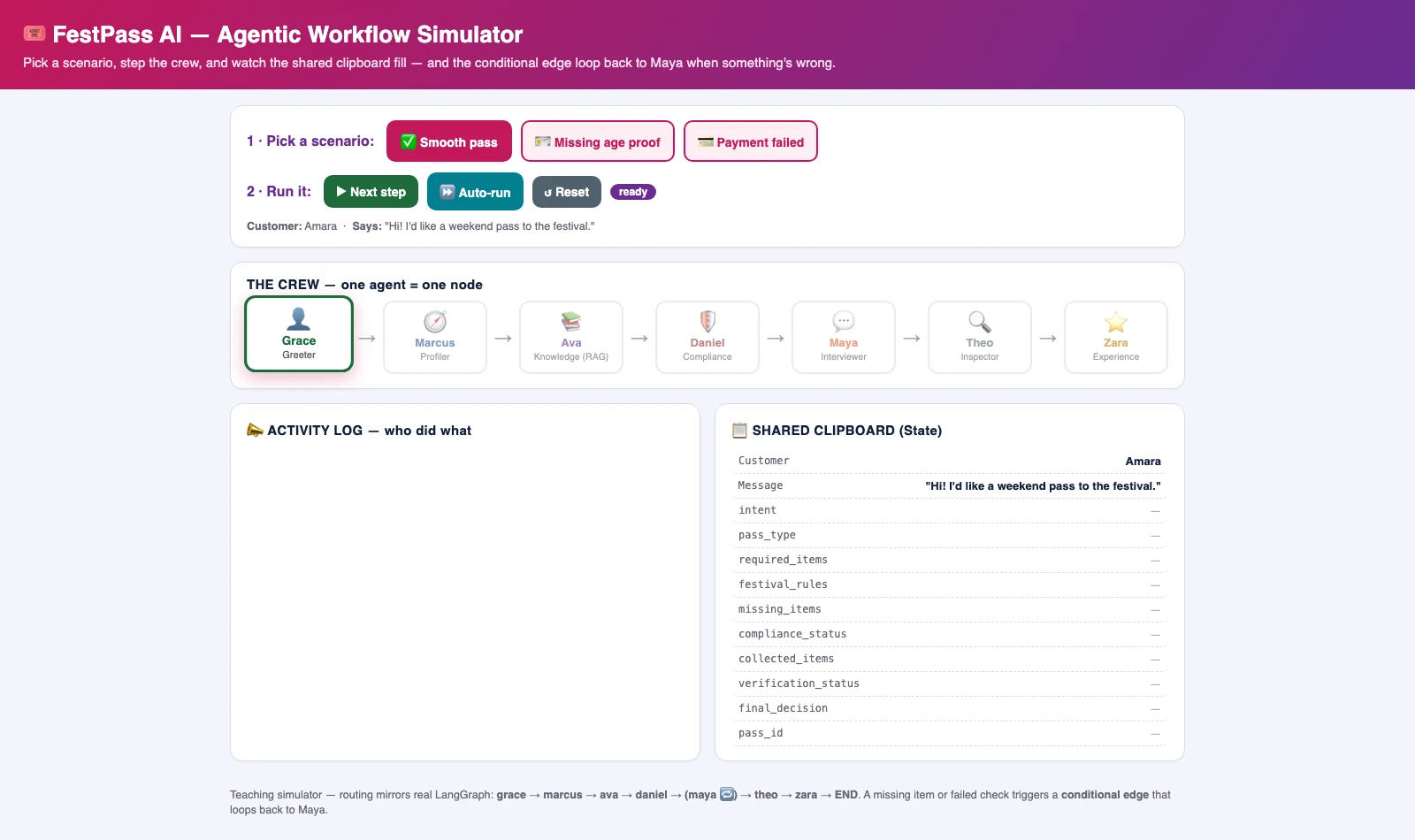
Agentic orchestration splits the work into nodes with defined jobs and explicit handoffs — classify the request, retrieve, check compliance, verify, escalate — rather than asking one model to do everything at once. Each step can be constrained, logged and tested on its own, and any step can refuse or hand off. It is the difference between producing an answer and running a process, and a process is the thing an organisation can put controls on.
Both patterns exist for the same reason, and it is not sophistication. It is liability. Retrieval buys provenance; orchestration buys control. Together they are what makes a language model something a regulated institution can actually put its name on.
Which is why the shapes recur across every build in this book. W.E.S refusing to return a balance without a valid token. A.I.D.A. wrapping a tax estimate in a mandatory disclaimer and routing anything harder to a staff console. ASPIRE AI adding output-schema checkers after its agents got tangled in testing. PILOT showing its sources with the date each was last checked, and handing anything touching customs to a human dispatcher.
None of those are novice flourishes. They are the working practices of the field, arrived at by teenagers who had a real client and therefore a real reason to need them.
That is a consultancy problem, not a coding exercise. And it is why, by late August, several teenage-led teams could stand in front of a regional technical panel and answer cross-examination about prompt injection.