The problem
It shouldn't talk to a 6-year-old the way it would talk to a 17-year-old.The Government of St Kitts and Nevis gives eligible young people an EC$1,000 financial start through the ASPIRE Programme (Achieving Success through Personal Investment, Resources and Education). Knowing that and understanding it are different things, and the gap between them is where a good scheme quietly fails. A six-year-old asking about ASPIRE and a seventeen-year-old asking about ASPIRE need two different conversations.
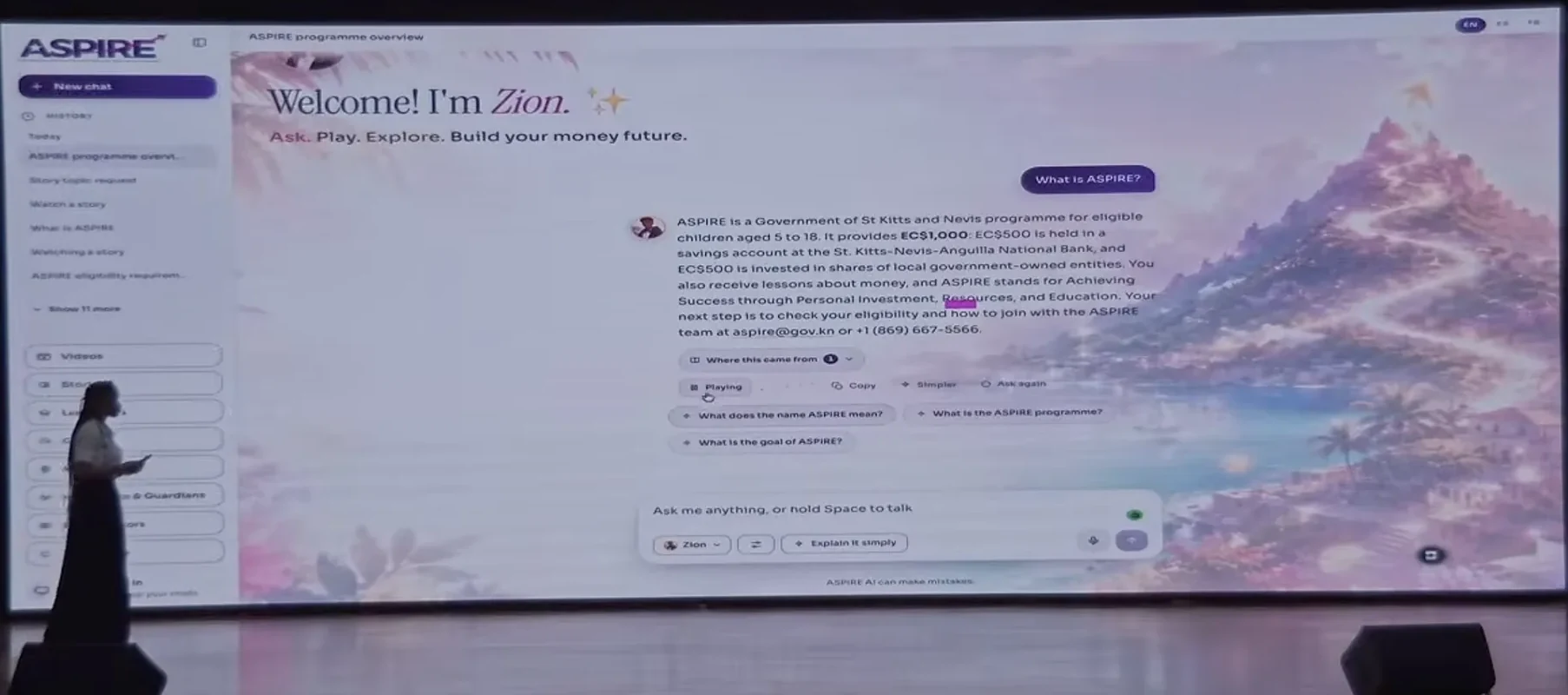
ASPIRE stands for Achieving Success through Personal Investment, Resources and Education. Of the EC$1,000 a young person receives, half is held in a savings account at the St Kitts-Nevis-Anguilla National Bank and half is invested in shares of local government-owned entities.
That is a lot of financial machinery to explain to someone who has just heard that the government is giving out money.
What they built
A multi-agent system with age-tiered guides, because it should not talk to a six-year-old the way it talks to a seventeen-year-old. Skye handles ages five to eight, where money is seeds that help children grow. Kaleb takes nine to twelve — saving, deposits, interest. Zion takes thirteen and up, into shares, eligibility and how the programme actually works. On top of the guide sits a tone engine: Zion can answer as The Professor, formal and precise, or as The Llama, colloquial and loose. Language switches live, mid-conversation, with context preserved, and the whole system is grounded strictly against Ministry of Finance circulars and ASPIRE statutes rather than the open internet.
- 3
- age-tiered guides
- 2
- tones per guide
- 68
- points, third place
- EC$1,000
- the grant explained
Skye (5–8), Kaleb (9–12), Zion (13+)
The Professor and The Llama
Chatbot Division
per eligible young person
What the judges pressed on
Dr David Farrell, the panel's chief judge, asked two questions.
"Is Aspire AI portable to other Eastern Caribbean territories launching youth wealth funds?" Yes, the team answered — the design is modular: swap the jurisdiction's documents, keep the age tiers.
"You utilized OpenAI, Claude, and Hugging Face rather than just Gemini. How do you govern multi-agent pipelines to avoid rogue behaviour?"
The turning point
The team did not deflect. In multi-turn testing their agents had got tangled up in one another; they fixed it with rigid system prompts and output-schema checkers, and said so on stage.
The guide sets the learning level; the personality sets the tone.Built with
- OpenAI
- Anthropic Claude
- Hugging Face
- RAG
The team
- Dre Martin — Coder, Presenter
- J'Nya Jack — Designer, Presenter
- Rayanna Morris-Greenidge — Team Leader, Designer, Presenter
- Amarni Moore
- Kylie Richards
- Cayden Williams
Financial literacy fails when it talks down to you or over your head — so they built a bot that changes who it is depending on who is asking.
Editorial review
Our reading of the build
An independent assessment by the editors of this publication — not the judges’ scoring, and not the team’s own account.
- Craft
- Age-tiering is easy to claim and hard to do. Most attempts amount to shorter sentences for younger users. This one changes the metaphor — money as seeds at five, deposits and interest at nine, shares and eligibility at thirteen — which means somebody thought about what a child can actually hold in their head at each stage rather than just adjusting reading level. Separating the guide from the tone is the sharper piece of design: two independent dials instead of six hard-coded personalities.
- What they learnt, and where it shows
- This is the clearest agentic build in the field, and also the one that hit the wall the curriculum warned about. Multi-agent orchestration was taught in week four; agents getting tangled in multi-turn conversation is precisely the failure that orchestration invites. The fix they reached for — rigid system prompts plus output-schema checkers — is the guardrails week and the structured-output discipline applied to a problem they discovered themselves, which is a better proof of learning than a working demo.
- Usability
- Live language switching with context preserved is genuinely difficult and largely invisible when it works, which is the mark of good engineering. The open question is discovery: a child does not know that Skye, Kaleb and Zion exist, or that a tone dial is available. Age-tiering only helps if the right tier is reached, and the routing between them deserves as much design attention as the tiers themselves.
- Scalability
- The team gave the honest answer on portability under questioning — swap the jurisdiction's documents, keep the age tiers — and it is the right one. The architecture is the transferable asset here, more than the content. The constraint is that three guides across multiple languages multiplies the surface being grounded, and every one of those combinations is a place where a statute could be quoted at the wrong reading age. Three models in the stack also means three sets of costs and three failure modes to monitor.
Images captured at the 2026 ECCU Chatbot & Multimedia Showcase, 28 August 2026. Screen captures have been cropped to remove browser and streaming interface; the chatbot interfaces and the presenters are unaltered.